 Solution Bowl
The current business environment presents operational challenges that exceed any previous period of history. Most organizations that include manufacturing facilities and retail businesses, and rapidly developing new enterprises, will have their staff members work with various software applications and spreadsheets, and manual tasks throughout the entire workday. The lack of appropriate assistance from anEnterprise Resource Planning company based in Gurgaon leads to communication problems, data storage issues, project delays, and employee dissatisfaction.
You are not the only person who experiences this situation. The same problem affects thousands of businesses throughout the National Capital Region. The implementation of a trustworthy enterprise solution results in a complete transformation of your business operations.
The blog will explain ERP as a term that describes a software system that solves business operational problems in Gurgaon through its enterprise resource planning service providers.
What Is an Enterprise Resource Planning System?
Enterprise Resource Planning systems function as integrated software solutions that link essential business operations, such as financial management, human resources, supply chain, production, sales, and other essential operations into one comprehensive system. Your organization functions from a single point of truth because all staff members use one main system instead of separate systems.
Organizations today can choose from three types of modern ERP systems, which include on-premise, cloud-based, and hybrid solutions. Cloud ERP software has become extremely popular in recent times because it provides customers with flexible usage options, requires less initial investment, and enables users to access the system from any location.
Modern ERP solutions come in various forms: on-premise, custom, and hybrid. In recent years, custom ERP software has gained massive popularity because of its flexibility, lower upfront cost, and ease of remote access.
Common Business Challenges That ERP Solves
Before diving into how to choose the right ERP company in Gurgaon, let us look at the common pain points that ERP is designed to fix:
- Data Silos: Different departments store data in different places, making it nearly impossible to get a complete picture of the business.
- Manual Errors: Relying on spreadsheets and manual data entry leads to costly mistakes in payroll, invoicing, and inventory.
- Poor Inventory Management: Without real-time tracking, businesses often face stockouts or overstocking, both of which hurt the bottom line.
- Slow Reporting: Gathering reports from multiple systems wastes hours that could be spent on strategy.
- Compliance Issues: Keeping up with GST filings, audits, and regulatory requirements becomes chaotic without a centralized system.
- Scalability Bottlenecks: As your business grows, outdated systems simply cannot keep up with the increasing load.
A well-implemented enterprise resource planning system addresses each of these issues systematically, saving time, reducing costs, and improving overall efficiency.
Why Choose an ERP Company in Gurgaon?
Gurgaon, now officially known as Gurugram, has emerged as one of India's most dynamic business hubs. Home to Fortune 500 companies, thriving startups, and a deep pool of technology talent, the city offers a unique advantage when it comes to finding ERP expertise.
Here is why working with an ERP company in Gurgaon makes sense for businesses across NCR:
- Local Market Understanding: Gurgaon-based ERP providers understand the nuances of Indian businesses' GST compliance, multi-lingual operations, local manufacturing norms, and more.
- On-Site Support: Having a vendor nearby means faster on-site assistance during implementation and post-deployment support.
- Industry-Specific Experience: Many ERP firms in Gurgaon have deep experience across sectors like automotive, FMCG, retail, healthcare, and IT services.
- Competitive Pricing: Compared to international vendors, Gurgaon-based companies offer enterprise-grade solutions at highly competitive rates.
- Integration with Indian Regulations: Local vendors build ERP systems with GST, TDS, and other statutory requirements baked in from day one.
Cloud ERP Software vs. On-Premise: What Should You Choose?
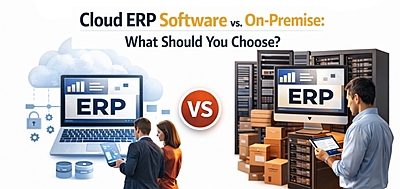
One of the most important decisions businesses face during ERP selection is whether to go for cloud ERP software or an on-premise solution. Both have their merits, and the right choice depends on your business size, budget, and IT infrastructure.
Here is a side-by-side comparison to help you decide:
| Feature | Cloud ERP Software | On-Premise ERP |
|---|---|---|
| Upfront Cost | Low, subscription-based pricing | High, one-time license fee |
| Deployment Time | Fast, weeks to go live | Longer months of setup |
| Accessibility | Anywhere, any device | Limited to the office network |
| Data Control | Managed by vendor | Full control in-house |
| Maintenance | Handled by the vendor automatically | Requires an internal IT team |
| Scalability | Highly scalable, add users easily | Requires hardware upgrades |
| Customization | Moderate | High |
| Best For | SMEs, remote teams, fast-growing companies | Large enterprises with strict data policies |
| Internet Dependency | Required | Not required |
| Long-Term Cost | Ongoing monthly/annual fees | Lower over time after initial investment |
A reputable ERP company in Gurgaon will help you evaluate both options and recommend the best fit based on your operational model and growth trajectory.
What Are the Best ERP Systems in the Market Today?
The market for the best ERP systems is highly competitive, with both global giants and specialized local players offering robust platforms. Some widely adopted solutions include SAP Business One, Oracle NetSuite, Microsoft Dynamics 365, Tally Prime, and Odoo. Each has its own strengths depending on company size, industry, and budget.
Rather than picking software based on brand name alone, the smarter approach is to define your business requirements first. A qualified ERP software company will conduct a thorough needs assessment, map your processes, and then recommend a platform that actually fits — not one that requires your business to adjust to the software.
Key features to look for in a top-tier ERP system include real-time analytics and dashboards, multi-location inventory management, automated financial reporting, CRM integration, HR and payroll modules, mobile accessibility, and strong customer support.
How to Choose the Right ERP Software Company for Your Business
Not all ERP vendors are created equal. Choosing the wrong implementation partner can result in cost overruns, project delays, and a system that employees resist using. Here is a practical checklist to evaluate any ERP software company before signing on the dotted line:
- Industry Experience: Has the vendor worked with businesses in your sector before? Ask for case studies or references.
- Implementation Methodology: A structured implementation process with clear milestones is non-negotiable.
- Customization Capabilities: Your business is unique. The ERP should adapt to your workflows, not the other way around.
- Training and Change Management: Even the best ERP fails if employees do not know how to use it. Look for vendors who include comprehensive training.
- Post-Implementation Support: What happens after go-live? Ensure the vendor offers ongoing support, maintenance, and upgrade services.
- Scalability: The ERP should grow with your business and accommodate future modules as needed.
- Total Cost of Ownership: Look beyond the license fee. Factor in implementation, training, customization, and support costs.
The Real Impact of ERP: What Businesses Experience After Implementation
The ROI from a well-deployed enterprise resource planning system is tangible and often visible within the first few months. Businesses commonly report the following improvements after going live:
- 30–40% reduction in manual data entry and associated errors
- Faster month-end closing cycles, sometimes reduced from weeks to days
- Improved inventory accuracy and reduction in carrying costs
- Better customer satisfaction due to faster order processing and delivery tracking
- Streamlined procurement and vendor management
- Greater employee productivity as routine tasks get automated
- Improved compliance and audit readiness
These results are not just numbers on a report. They represent real time saved, real money recovered, and real momentum for business growth.
Questions to Ask Before You Begin Your ERP Journey
Before reaching out to any ERP company in Gurgaon, it helps to have internal clarity on a few key questions:
- What are the top three operational problems I want ERP to solve?
- How many users will need access to the system?
- Do we have dedicated IT resources, or do we need a fully managed cloud ERP solution?
- What is our realistic budget, including implementation and ongoing costs?
- Which departments need to be integrated in Phase 1?
- What does our timeline look like for going live?
Having answers to these questions makes your first conversation with an ERP vendor far more productive and helps you avoid common pitfalls.
Final Thoughts: Your Business Deserves Better Operations
Business operations will only get more complex as your company scales. Trying to manage growth with disconnected tools and manual processes is like trying to run a marathon in flip-flops. It is technically possible. Still, it will cost you dearly in time, energy, and money.
Investing in an enterprise resource planning system is not just a technology decision; it is a strategic one. And working with the right ERP company in Gurgaon ensures that your investment is backed by local expertise, reliable support, and a deep understanding of the challenges businesses in this region face every day.
Whether you are considering cloud ERP software for its flexibility or looking for a fully customized on-premise solution, the journey starts with a conversation. Reach out to a trusted ERP software company in Gurgaon today and take the first step toward smoother, smarter, and more profitable operations.